

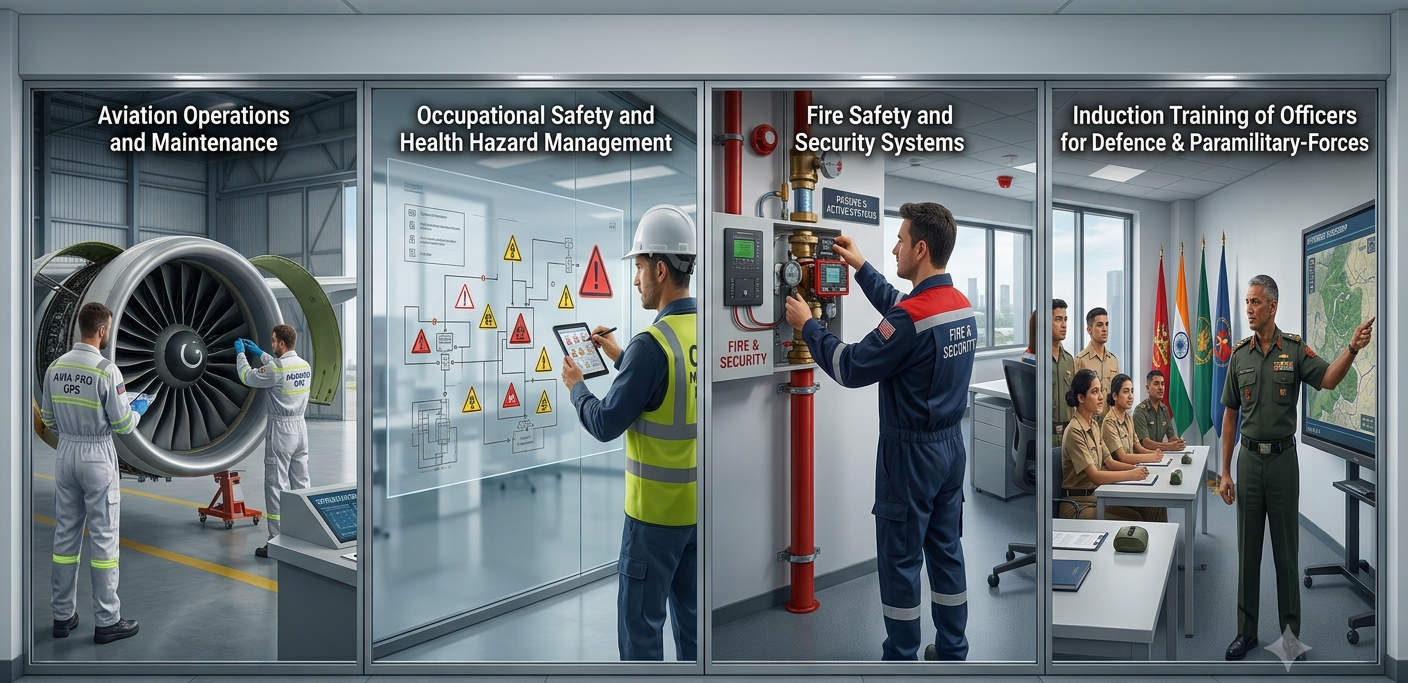
Occupational Safety and Health Hazard Management Excellence | GRES
In today’s industrial and corporate landscapes, mitigating workplace risks is not just a regulatory obligation—it is a foundational pillar of operational sustainability and corporate responsibility. GRES delivers comprehensive, elite-level Occupational Safety and Health (OSH) Hazard Management solutions engineered to safeguard your most valuable asset: your workforce.
From heavy manufacturing plants to high-security corporate environments, GRES identifies hidden vulnerabilities, enforces strict compliance parameters, and designs custom safety architectures that drive zero-incident workplace cultures.
Advanced Workplace Risk & Hazard Identification
Effective hazard management begins with anticipating risks before they manifest as operational disruptions or workplace injuries. GRES employs predictive risk assessment models to map out site-specific physical, chemical, and biological threats.
Job Safety Analysis (JSA) & HIRA
We conduct exhaustive Hazard Identification and Risk Assessment (HIRA) workflows for every tier of your operations.
- Task-Based Evaluations: Breaking down complex mechanical and operational procedures into discrete steps to identify point-of-failure risks.
- Quantitative Risk Modelling: Utilizing data-driven matrices to score risks based on severity, exposure frequency, and probability, ensuring your safety budget is targeted where it matters most.
Industrial Hygiene & Environmental Monitoring
Workplace hazards are frequently invisible. GRES utilizes calibrated analytical instrumentation to assess environmental contaminants that impact long-term health.
- Air Quality & Chemical Exposure: Continuous monitoring of airborne particulates, volatile organic compounds (VOCs), toxic gases, and localized oxygen depletion.
- Physical Agent Mitigation: Field testing and acoustic modelling for occupational noise levels, whole-body vibration tracking, and thermal stress assessments in high-heat industrial zones.
Integrated Safety Architecture & Control Strategies
Once hazards are catalogued, GRES applies the globally recognized Hierarchy of Controls to isolate or completely eliminate operational risks.
Engineering and Isolation Controls
We design physical barriers and automated safeguards to remove human error from dangerous industrial zones.
- Machine Guarding & Interlocking: Custom structural shielding around high-speed rotables, presses, and automated robotics lines.
- Local Exhaust Ventilation (LEV): Engineering specialized extraction setups to pull hazardous dusts, fumes, and mists directly away from the operator's breathing zone.
Ergonomic Assessment & Human Factors Engineering
GRES mitigates musculoskeletal disorders (MSDs)—the leading cause of long-term worker absenteeism—by optimizing the physical workspace.
- Biomechanical Analysis: Assessing lifting tasks, repetitive motions, and awkward postures using standard REBA/RULA assessment tools.
- Workspace Redesign: Modifying assembly lines, control rooms, and corporate office layouts to match natural human kinetics and reduce structural physical strain.
Regulatory Compliance & Global Safety Standards
Navigating international labour regulations requires absolute precision. GRES aligns your standard operating procedures with the world's most stringent regulatory frameworks to eliminate legal liabilities and insurance penalties.
ISO 45001 Certification & Management Systems
We design, implement, and audit Occupational Health and Safety Management Systems (OHSMS) tailored specifically to your company's scale.
- Audit Readiness: Continuous internal compliance gap-analysis to satisfy local occupational health authorities (such as OSHA, HSE, or national labour ministries).
- Documentation Architecture: Drafting ironclad safety manuals, incident reporting logs, and standard operating procedures (SOPs) that stand up to regulatory legal cross-examination.
Incident Investigation & Root Cause Analysis (RCA)
In the event of a near-miss or actual incident, GRES deploys dedicated forensic safety inspectors to ensure the root cause is systematically and permanently corrected.
- Methodologies: Applying rigorous analytical techniques to decouple human error from systemic procedural failures.
- Corrective and Preventive Actions (CAPA): Creating clear, trackable timelines for engineering changes and training overhauls to prevent incident recurrence.
Specialized Hazard Training & Emergency Preparedness
A safety system is only as strong as the frontline workers executing it. GRES converts complex safety regulations into high-retention, high-impact training initiatives.
High-Risk Environmental Training
- Confined Space Entry & Rescue: Comprehensive certified courses focusing on atmospheric testing, permit-to-work systems, and specialized extraction rigging.
- Lockout/Tagout (LOTO): Developing rigorous zero-energy state verification protocols for multi-craft industrial maintenance shutdowns.
- Working at Heights: Fall protection system training, anchoring geometry, and comprehensive suspension trauma mitigation protocols.
Crisis Management & Business Continuity
When a massive workplace crisis strikes, minutes dictate lives. GRES builds robust emergency action plans (EAPs) tailored to catastrophic operational failures.
- Mass Casualty & Evacuation Routing: Designing dynamically lit, fail-safe escape corridors and command structures.
- Hazardous Materials (HAZMAT) Spills: Equipping and training rapid-response containment units to manage chemical breaches before they escape secondary containment areas.